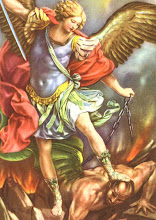
The Acts of the Apostles: 12, 1-25
**************************************************
THE MARTYRDOM OF ST.JAMES THE GREATER
*****************************************************************
Now about that time Herod the king put forth his hands to afflict certain of the church
_______________________________§_____________________________
12:1Now about that time Herod the king put forth his hands to afflict certain of the church. 12:2And he killed James the brother of John with the sword. 12:3And when he saw that it pleased the Jews, he proceeded to seize Peter also. And those were the days of unleavened bread. 12:4And when he had taken him, he put him in prison, and delivered him to four quaternions of soldiers to guard him; intending after the Passover to bring him forth to the people. 12:5Peter therefore was kept in the prison: but prayer was made earnestly of the church unto God for him. 12:6And when Herod was about to bring him forth, the same night Peter was sleeping between two soldiers, bound with two chains: and guards before the door kept the prison. 12:7And behold, an angel of the Lord stood by him, and a light shined in the cell: and he smote Peter on the side, and awoke him, saying, Rise up quickly. And his chains fell off from his hands. 12:8And the angel said unto him, Gird thyself, and bind on thy sandals. And he did so. And he saith unto him, Cast thy garment about thee, and follow me. 12:9And he went out, and followed; and he knew not that it was true which was done by the angel, but thought he saw a vision. 12:10And when they were past the first and the second guard, they came unto the iron gate that leadeth into the city; which opened to them of its own accord: and they went out, and passed on through one street; and straightway the angel departed from him. 12:11And when Peter was come to himself, he said, Now I know of a truth, that the Lord hath sent forth his angel and delivered me out of the hand of Herod, and from all the expectation of the people of the Jews. 12:12And when he had considered the thing, he came to the house of Mary the mother of John whose surname was Mark; where many were gathered together and were praying. 12:13And when he knocked at the door of the gate, a maid came to answer, named Rhoda. 12:14And when she knew Peter's voice, she opened not the gate for joy, but ran in, and told that Peter stood before the gate. 12:15And they said unto her, Thou art mad. But she confidently affirmed that it was even so. And they said, It is his angel. 12:16But Peter continued knocking: and when they had opened, they saw him, and were amazed. 12:17But he, beckoning unto them with the hand to hold their peace, declared unto them how the Lord had brought him forth out of the prison. And he said, Tell these things unto James, and to the brethren. And he departed, and went to another place. 12:18Now as soon as it was day, there was no small stir among the soldiers, what was become of Peter. 12:19And when Herod had sought for him, and found him not, he examined the guards, and commanded that they should be put to death. And he went down from Judaea to Caesarea, and tarried there. 12:20Now he was highly displeased with them of Tyre and Sidon: and they came with one accord to him, and, having made Blastus the king's chamberlain their friend, they asked for peace, because their country was fed from the king's country. 12:21And upon a set day Herod arrayed himself in royal apparel, and sat on the throne, and made an oration unto them. 12:22And the people shouted, saying, The voice of a god, and not of a man. 12:23And immediately an angel of the Lord smote him, because he gave not God the glory: and he was eaten of worms, and gave up the ghost. 12:24But the word of God grew and multiplied. 12:25And Barnabas and Saul returned from Jerusalem, when they had fulfilled their ministration, taking with them John whose surname was Mark.
http://www.earlychristianwritings.com/text/acts-asv.html
http://groups.google.com/group/christianbiblestudies?hl=it
Visualizzazione post con etichetta the greater. Mostra tutti i post
Visualizzazione post con etichetta the greater. Mostra tutti i post
mercoledì 30 luglio 2008

ST.JAMES THE GREATER
WALDTRAUD
Philippians 4:19 and 1 Thessalonians 5:18 -
And my God will meet all your needs according to his glorious riches in
Christ Jesus.
...give thanks in all circumstances, for this is God's will for you in
Christ Jesus.
____________________________________________________________________________
Lord, I am willing to -
Receive what you give,
Lack what you withhold,
Relinquish what you take.
<><><><><>
July 25th - St. James the Greater
(Hebrew Yakob; Septuagint Iakob; N.T. Greek Iakobos; a favourite name among
the
later Jews).
The son of Zebedee and Salome (Cf. Matthew 27:56; Mark 15:40; 16:1). Zahn
asserts that Salome was the daughter of a priest. James is styled "the
Greater"
to distinguish him from the Apostle James "the Less", who was probably
shorter
of stature. We know nothing of St. James's early life. He was the brother of
John, the beloved disciple, and probably the elder of the two.
His parents seem to have been people of means as appears from the following
facts.
* Zebedee was a fisherman of the Lake of Galilee, who probably lived in
or
near Bethsaida (John 1:44), perhaps in Capharnaum; and had some boatmen or
hired
men as his usual attendants (Mark 1:20).
* Salome was one of the pious women who afterwards followed Christ and
"ministered unto him of their substance" (cf. Matthew 27:55, sq.; Mark
15:40;
16:1; Luke 8:2 sq.; 23:55-24:1).
* St. John was personally known to the high-priest (John 18:16); and
must
have had wherewithal to provide for the Mother of Jesus (John 19:27).
It is probable, according to Acts 4:13, that John (and consequently his
brother
James) had not received the technical training of the rabbinical schools; in
this sense they were unlearned and without any official position among the
Jews.
But, according to the social rank of their parents, they must have been men
of
ordinary education, in the common walks of Jewish life. They had frequent
opportunity of coming in contact with Greek life and language, which were
already widely spread along the shores of the Galilean Sea.
Relation of St. James to Jesus
Some authors, comparing John 19:25 with Matthew 28:56 and Mark 15:40,
identify,
and probably rightly so, Mary the Mother of James the Less and of Joseph in
Mark
and Matthew with "Mary of Cleophas" in John. As the name of Mary Magdalen
occurs
in the three lists, they identify further Salome in Mark with "the mother of
the
sons of Zebedee" in Matthew; finally they identify Salome with "his mother's
sister" in John. They suppose, for this last identification, that four women
are
designated by John 19:25; the Syriac "Peshito" gives the reading: "His
mother
and his mother's sister, and Mary of Cleophas and Mary Magdalen." If this
last
supposition is right, Salome was a sister of the Blessed Virgin Mary, and
James
the Greater and John were first cousins of the Lord; this may explain the
discipleship of the two brothers, Salome's request and their own claim to
the
first position in His kingdom, and His commendation of the Blessed Virgin to
her
own nephew. But it is doubtful whether the Greek admits of this construction
without the addition or the omission of kai (and). Thus the relationship of
St.
James to Jesus remains doubtful.
His life and apostolate
The Galilean origin of St. James in some degree explains the energy of
temper
and the vehemence of character which earned for him and St. John the name of
Boanerges, "sons of thunder" (Mark 3:17); the Galilean race was religious,
hardy, industrious, brave, and the strongest defender of the Jewish nation.
When John the Baptist proclaimed the kingdom of the Messias, St. John became
a
disciple (John 1:35); he was directed to "the Lamb of God" and afterwards
brought his brother James to the Messias; the obvious meaning of John 1:41,
is
that St. Andrew finds his brother (St. Peter) first and that afterwards St.
John
(who does not name himself, according to his habitual and characteristic
reserve
and silence about himself) finds his brother (St. James). The call of St.
James
to the discipleship of the Messias is reported in a parallel or identical
narration by Matthew 4:18-22; Mark 1:19 sq.; and Luke 5:1-11. The two sons
of
Zebedee, as well as Simon (Peter) and his brother Andrew with whom they were
in
partnership (Luke 5:10), were called by the Lord upon the Sea of Galilee,
where
all four with Zebedee and his hired servants were engaged in their ordinary
occupation of fishing. The sons of Zebedee "forthwith left their nets and
father, and followed him" (Matthew 4:22), and became "fishers of men".
St. James was afterwards with the other eleven called to the Apostleship
(Matthew 10:1-4; Mark 3:13-19; Luke 6:12-16; Acts 1:13). In all four lists
the
names of Peter and Andrew, James and John form the first group, a prominent
and
chosen group (cf. Mark 13:3); especially Peter, James, and John. These three
Apostles alone were admitted to be present at the miracle of the raising of
Jairus's daughter (Mark 5:37; Luke 8:51), at the Transfiguration (Mark 9:1;
Matthew 17:1; Luke 9:28), and the Agony in Gethsemani (Matthew 26:37; Mark
14:33). The fact that the name of James occurs always (except in Luke 8:51;
9:28; Acts 1:13 -- Greek Text) before that of his brother seems to imply
that
James was the elder of the two. It is worthy of notice that James is never
mentioned in theGospel of St. John; this author observes a humble reserve
not
only with regard to himself, but also about the members of his family.
Several incidents scattered through the Synoptics suggest that James and
John
had that particular character indicated by the name "Boanerges," sons of
thunder, given to them by the Lord (Mark 3:17); they were burning and
impetuous
in their evangelical zeal and severe in temper. The two brothers showed
their
fiery temperament against "a certain man casting out devils" in the name of
the
Christ; John, answering, said: "We [James is probably meant] forbade him,
because he followeth not with us" (Luke 9:49). When the Samaritans refused
to
receive Christ, James and John said: "Lord, wilt thou that we command fire
to
come down from heaven, and consume them?" (Luke 9:54; cf. 9:49).
His martyrdom
On the last journey to Jerusalem, their mother Salome came to the Lord and
said
to Him: "Say that these my two sons may sit, the one on thy right hand, and
the
other on thy left, in thy kingdom" (Matthew 20:21). And the two brothers,
still
ignorant of the spiritual nature of the Messianic Kingdom, joined with their
mother in this eager ambition (Mark 10:37). And on their assertion that they
are
willing to drink the chalice that He drinks of, and to be baptized with the
baptism of His sufferings, Jesus assured them that they will share His
sufferings (Mark 5:38-39).
James won the crown of martyrdom fourteen years after this prophecy, A.D.
44.
Herod Agrippa I, son of Aristobulus and grandson of Herod the Great, reigned
at
that time as "king" over a wider dominion than that of his grandfather. His
great object was to please the Jews in every way, and he showed great regard
for
the Mosaic Law and Jewish customs. In pursuance of this policy, on the
occasion
of the Passover of A.D. 44, he perpetrated cruelties upon the Church, whose
rapid growth incensed the Jews. The zealous temper of James and his leading
part
in the Jewish Christian communities probably led Agrippa to choose him as
the
first victim. "He killed James, the brother of John, with the sword." (Acts
12:1-2). According to a tradition, which, as we learn from Eusebius (Hist.
Eccl., II, ix, 2, 3), was received from Clement of Alexandria (in the
seventh
book of his lost "Hypotyposes"), the accuser who led the Apostle to
judgment,
moved by his confession, became himself a Christian, and they were beheaded
together. As Clement testifies expressly that the account was given him "by
those who were before him," this tradition has a better foundation than many
other traditions and legends respecting the Apostolic labours and death of
St.
James, which are related in the Latin "Passio Jacobi Majoris", the Ethiopic
"Acts of James", and so on.
St. James in Spain
The tradition asserting that James the Greater preached the Gospel in Spain,
and
that his body was translated to Compostela, claims more serious
consideration.
According to this tradition St. James the Greater, having preached
Christianity
in Spain, returned to Judea and was put to death by order of Herod; his body
was
miraculously translated to Iria Flavia in the northwest of Spain, and later
to
Compostela, which town, especially during the Middle Ages, became one of the
most famous places of pilgrimage in the world. The vow of making a
pilgrimage to
Compostela to honour the sepulchre of St. James is still reserved to the
pope,
who alone of his own or ordinary right can dispense from it. In the twelfth
century was founded the Order of Knights of St. James of Compostela.
With regard to the preaching of the Gospel in Spain by St. James the
greater,
several difficulties have been raised:
* St. James suffered martyrdom A.D. 44 (Acts 12:2), and, according to
the
tradition of the early Church, he had not yet left Jerusalem at this time
(cf.
Clement of Alexandria, "Strom.", VI; Apollonius, quoted by Eusebius, "Hist.
Eccl." VI, xviii).
* St. Paul in his Epistle to the Romans (A.D. 58) expressed the
intention to
visit Spain (Romans 15:24) just after he had mentioned (15:20) that he did
not
"build upon another man's foundation."
* The argument ex silentio: although the tradition that James founded an
Apostolic see in Spain was current in the year 700, no certain mention of
such
tradition is to be found in the genuine writings of early writers nor in the
early councils; the first certain mention we find in the ninth century, in
Notker, a monk of St. Gall (Martyrol., 25 July), Walafried Strabo (Poema de
XII
Apost.), and others.
* The tradition was not unanimously admitted afterwards, while numerous
scholars reject it. The Bollandists however defended it (see Acta Sanctorum,
July, VI and VII, where other sources are given).
The authenticity of the sacred relic of Compostela has been questioned and
is
still doubted. Even if St. James the Greater did not preach the Christian
religion in Spain, his body may have been brought to Compostela, and this
was
already the opinion of Notker. According to another tradition, the relics of
the
Apostle are kept in the church of St-Saturnin at Toulouse (France), but it
is
not improbable that such sacred relics should have been divided between two
churches. A strong argument in favour of the authenticity of the sacred
relics
of Compostela is the Bull of Leo XIII, "Omnipotens Deus," of 1 November,
1884.
From
http://www.newadvent.org/cathen/08279b.htm
Saint Quote:
Thou knowest well how to excuse and color thine own deeds; but thou art not
willing to receive the excuses of others. It were more just that thou
shouldest
accuse thyself, and excuse thy brother.
-Thomas à Kempis
Bible Quote:
"I count all things but loss for the excellency of the knowledge of
Christ Jesus my Lord: for whom I have suffered the loss of all things,
and do count them but dung, that I may win Christ, And be found in
him, not having mine own righteousness, which is of the law, but that
which is through the faith of Christ, the righteousness which is of
God by faith" (Philippians 3:8-9)
<><><><>
St. Teresa's Bookmark
Let nothing disturb thee.
Let nothing affright thee.
All things are passing.
Only God is changeless.
Patience attaineth all things.
Whoever hath God
lacks for nothing.
God alone suffices!
St. Teresa of Avila
http://groups.google.com/group/alt.religion.christian.campus-crusade/browse_frm/thread/73fa35a8ef47ea4f?hl=it#
Philippians 4:19 and 1 Thessalonians 5:18 -
And my God will meet all your needs according to his glorious riches in
Christ Jesus.
...give thanks in all circumstances, for this is God's will for you in
Christ Jesus.
____________________________________________________________________________
Lord, I am willing to -
Receive what you give,
Lack what you withhold,
Relinquish what you take.
<><><><><>
July 25th - St. James the Greater
(Hebrew Yakob; Septuagint Iakob; N.T. Greek Iakobos; a favourite name among
the
later Jews).
The son of Zebedee and Salome (Cf. Matthew 27:56; Mark 15:40; 16:1). Zahn
asserts that Salome was the daughter of a priest. James is styled "the
Greater"
to distinguish him from the Apostle James "the Less", who was probably
shorter
of stature. We know nothing of St. James's early life. He was the brother of
John, the beloved disciple, and probably the elder of the two.
His parents seem to have been people of means as appears from the following
facts.
* Zebedee was a fisherman of the Lake of Galilee, who probably lived in
or
near Bethsaida (John 1:44), perhaps in Capharnaum; and had some boatmen or
hired
men as his usual attendants (Mark 1:20).
* Salome was one of the pious women who afterwards followed Christ and
"ministered unto him of their substance" (cf. Matthew 27:55, sq.; Mark
15:40;
16:1; Luke 8:2 sq.; 23:55-24:1).
* St. John was personally known to the high-priest (John 18:16); and
must
have had wherewithal to provide for the Mother of Jesus (John 19:27).
It is probable, according to Acts 4:13, that John (and consequently his
brother
James) had not received the technical training of the rabbinical schools; in
this sense they were unlearned and without any official position among the
Jews.
But, according to the social rank of their parents, they must have been men
of
ordinary education, in the common walks of Jewish life. They had frequent
opportunity of coming in contact with Greek life and language, which were
already widely spread along the shores of the Galilean Sea.
Relation of St. James to Jesus
Some authors, comparing John 19:25 with Matthew 28:56 and Mark 15:40,
identify,
and probably rightly so, Mary the Mother of James the Less and of Joseph in
Mark
and Matthew with "Mary of Cleophas" in John. As the name of Mary Magdalen
occurs
in the three lists, they identify further Salome in Mark with "the mother of
the
sons of Zebedee" in Matthew; finally they identify Salome with "his mother's
sister" in John. They suppose, for this last identification, that four women
are
designated by John 19:25; the Syriac "Peshito" gives the reading: "His
mother
and his mother's sister, and Mary of Cleophas and Mary Magdalen." If this
last
supposition is right, Salome was a sister of the Blessed Virgin Mary, and
James
the Greater and John were first cousins of the Lord; this may explain the
discipleship of the two brothers, Salome's request and their own claim to
the
first position in His kingdom, and His commendation of the Blessed Virgin to
her
own nephew. But it is doubtful whether the Greek admits of this construction
without the addition or the omission of kai (and). Thus the relationship of
St.
James to Jesus remains doubtful.
His life and apostolate
The Galilean origin of St. James in some degree explains the energy of
temper
and the vehemence of character which earned for him and St. John the name of
Boanerges, "sons of thunder" (Mark 3:17); the Galilean race was religious,
hardy, industrious, brave, and the strongest defender of the Jewish nation.
When John the Baptist proclaimed the kingdom of the Messias, St. John became
a
disciple (John 1:35); he was directed to "the Lamb of God" and afterwards
brought his brother James to the Messias; the obvious meaning of John 1:41,
is
that St. Andrew finds his brother (St. Peter) first and that afterwards St.
John
(who does not name himself, according to his habitual and characteristic
reserve
and silence about himself) finds his brother (St. James). The call of St.
James
to the discipleship of the Messias is reported in a parallel or identical
narration by Matthew 4:18-22; Mark 1:19 sq.; and Luke 5:1-11. The two sons
of
Zebedee, as well as Simon (Peter) and his brother Andrew with whom they were
in
partnership (Luke 5:10), were called by the Lord upon the Sea of Galilee,
where
all four with Zebedee and his hired servants were engaged in their ordinary
occupation of fishing. The sons of Zebedee "forthwith left their nets and
father, and followed him" (Matthew 4:22), and became "fishers of men".
St. James was afterwards with the other eleven called to the Apostleship
(Matthew 10:1-4; Mark 3:13-19; Luke 6:12-16; Acts 1:13). In all four lists
the
names of Peter and Andrew, James and John form the first group, a prominent
and
chosen group (cf. Mark 13:3); especially Peter, James, and John. These three
Apostles alone were admitted to be present at the miracle of the raising of
Jairus's daughter (Mark 5:37; Luke 8:51), at the Transfiguration (Mark 9:1;
Matthew 17:1; Luke 9:28), and the Agony in Gethsemani (Matthew 26:37; Mark
14:33). The fact that the name of James occurs always (except in Luke 8:51;
9:28; Acts 1:13 -- Greek Text) before that of his brother seems to imply
that
James was the elder of the two. It is worthy of notice that James is never
mentioned in theGospel of St. John; this author observes a humble reserve
not
only with regard to himself, but also about the members of his family.
Several incidents scattered through the Synoptics suggest that James and
John
had that particular character indicated by the name "Boanerges," sons of
thunder, given to them by the Lord (Mark 3:17); they were burning and
impetuous
in their evangelical zeal and severe in temper. The two brothers showed
their
fiery temperament against "a certain man casting out devils" in the name of
the
Christ; John, answering, said: "We [James is probably meant] forbade him,
because he followeth not with us" (Luke 9:49). When the Samaritans refused
to
receive Christ, James and John said: "Lord, wilt thou that we command fire
to
come down from heaven, and consume them?" (Luke 9:54; cf. 9:49).
His martyrdom
On the last journey to Jerusalem, their mother Salome came to the Lord and
said
to Him: "Say that these my two sons may sit, the one on thy right hand, and
the
other on thy left, in thy kingdom" (Matthew 20:21). And the two brothers,
still
ignorant of the spiritual nature of the Messianic Kingdom, joined with their
mother in this eager ambition (Mark 10:37). And on their assertion that they
are
willing to drink the chalice that He drinks of, and to be baptized with the
baptism of His sufferings, Jesus assured them that they will share His
sufferings (Mark 5:38-39).
James won the crown of martyrdom fourteen years after this prophecy, A.D.
44.
Herod Agrippa I, son of Aristobulus and grandson of Herod the Great, reigned
at
that time as "king" over a wider dominion than that of his grandfather. His
great object was to please the Jews in every way, and he showed great regard
for
the Mosaic Law and Jewish customs. In pursuance of this policy, on the
occasion
of the Passover of A.D. 44, he perpetrated cruelties upon the Church, whose
rapid growth incensed the Jews. The zealous temper of James and his leading
part
in the Jewish Christian communities probably led Agrippa to choose him as
the
first victim. "He killed James, the brother of John, with the sword." (Acts
12:1-2). According to a tradition, which, as we learn from Eusebius (Hist.
Eccl., II, ix, 2, 3), was received from Clement of Alexandria (in the
seventh
book of his lost "Hypotyposes"), the accuser who led the Apostle to
judgment,
moved by his confession, became himself a Christian, and they were beheaded
together. As Clement testifies expressly that the account was given him "by
those who were before him," this tradition has a better foundation than many
other traditions and legends respecting the Apostolic labours and death of
St.
James, which are related in the Latin "Passio Jacobi Majoris", the Ethiopic
"Acts of James", and so on.
St. James in Spain
The tradition asserting that James the Greater preached the Gospel in Spain,
and
that his body was translated to Compostela, claims more serious
consideration.
According to this tradition St. James the Greater, having preached
Christianity
in Spain, returned to Judea and was put to death by order of Herod; his body
was
miraculously translated to Iria Flavia in the northwest of Spain, and later
to
Compostela, which town, especially during the Middle Ages, became one of the
most famous places of pilgrimage in the world. The vow of making a
pilgrimage to
Compostela to honour the sepulchre of St. James is still reserved to the
pope,
who alone of his own or ordinary right can dispense from it. In the twelfth
century was founded the Order of Knights of St. James of Compostela.
With regard to the preaching of the Gospel in Spain by St. James the
greater,
several difficulties have been raised:
* St. James suffered martyrdom A.D. 44 (Acts 12:2), and, according to
the
tradition of the early Church, he had not yet left Jerusalem at this time
(cf.
Clement of Alexandria, "Strom.", VI; Apollonius, quoted by Eusebius, "Hist.
Eccl." VI, xviii).
* St. Paul in his Epistle to the Romans (A.D. 58) expressed the
intention to
visit Spain (Romans 15:24) just after he had mentioned (15:20) that he did
not
"build upon another man's foundation."
* The argument ex silentio: although the tradition that James founded an
Apostolic see in Spain was current in the year 700, no certain mention of
such
tradition is to be found in the genuine writings of early writers nor in the
early councils; the first certain mention we find in the ninth century, in
Notker, a monk of St. Gall (Martyrol., 25 July), Walafried Strabo (Poema de
XII
Apost.), and others.
* The tradition was not unanimously admitted afterwards, while numerous
scholars reject it. The Bollandists however defended it (see Acta Sanctorum,
July, VI and VII, where other sources are given).
The authenticity of the sacred relic of Compostela has been questioned and
is
still doubted. Even if St. James the Greater did not preach the Christian
religion in Spain, his body may have been brought to Compostela, and this
was
already the opinion of Notker. According to another tradition, the relics of
the
Apostle are kept in the church of St-Saturnin at Toulouse (France), but it
is
not improbable that such sacred relics should have been divided between two
churches. A strong argument in favour of the authenticity of the sacred
relics
of Compostela is the Bull of Leo XIII, "Omnipotens Deus," of 1 November,
1884.
From
http://www.newadvent.org/cathen/08279b.htm
Saint Quote:
Thou knowest well how to excuse and color thine own deeds; but thou art not
willing to receive the excuses of others. It were more just that thou
shouldest
accuse thyself, and excuse thy brother.
-Thomas à Kempis
Bible Quote:
"I count all things but loss for the excellency of the knowledge of
Christ Jesus my Lord: for whom I have suffered the loss of all things,
and do count them but dung, that I may win Christ, And be found in
him, not having mine own righteousness, which is of the law, but that
which is through the faith of Christ, the righteousness which is of
God by faith" (Philippians 3:8-9)
<><><><>
St. Teresa's Bookmark
Let nothing disturb thee.
Let nothing affright thee.
All things are passing.
Only God is changeless.
Patience attaineth all things.
Whoever hath God
lacks for nothing.
God alone suffices!
St. Teresa of Avila
http://groups.google.com/group/alt.religion.christian.campus-crusade/browse_frm/thread/73fa35a8ef47ea4f?hl=it#
Iscriviti a:
Commenti (Atom)