CHRISTIAN RELIGION ARTICLES

Visualizzazione post con etichetta lord. Mostra tutti i post

lunedì 2 febbraio 2009

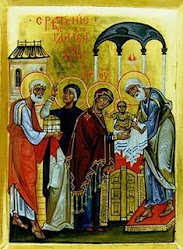
The Presentation of the Lord - Feast


* Monday, 2 February 2009
The Presentation of the Lord - Feast


Holy Gospel of Jesus Christ according to Saint Luke 2,22-40.

When the days were completed for their purification according to the law of Moses, they took him up to Jerusalem to present him to the Lord,
just as it is written in the law of the Lord, "Every male that opens the womb shall be consecrated to the Lord,"
and to offer the sacrifice of "a pair of turtledoves or two young pigeons," in accordance with the dictate in the law of the Lord.
Now there was a man in Jerusalem whose name was Simeon. This man was righteous and devout, awaiting the consolation of Israel, and the holy Spirit was upon him.
It had been revealed to him by the holy Spirit that he should not see death before he had seen the Messiah of the Lord.
He came in the Spirit into the temple; and when the parents brought in the child Jesus to perform the custom of the law in regard to him,
he took him into his arms and blessed God, saying:
Now, Master, you may let your servant go in peace, according to your word,
for my eyes have seen your salvation,
which you prepared in sight of all the peoples,
a light for revelation to the Gentiles, and glory for your people Israel."
The child's father and mother were amazed at what was said about him;
and Simeon blessed them and said to Mary his mother, "Behold, this child is destined for the fall and rise of many in Israel, and to be a sign that will be contradicted
(and you yourself a sword will pierce) so that the thoughts of many hearts may be revealed."
There was also a prophetess, Anna, the daughter of Phanuel, of the tribe of Asher. She was advanced in years, having lived seven years with her husband after her marriage,
and then as a widow until she was eighty-four. She never left the temple, but worshiped night and day with fasting and prayer.
And coming forward at that very time, she gave thanks to God and spoke about the child to all who were awaiting the redemption of Jerusalem.
When they had fulfilled all the prescriptions of the law of the Lord, they returned to Galilee, to their own town of Nazareth.
The child grew and became strong, filled with wisdom; and the favor of God was upon him.


02 February
--------------------------------------------------------------------------------


The Presentation of Child Jesus in the Temple


THE law of God, given by Moses to the Jews, ordained that a woman, after childbirth, should continue for a certain time in a state which that law calls unclean, during which she was not to appear in public, nor presume to touch anything consecrated to God. This term was of forty days upon the birth of a son, and double that time for a daughter. On the expiration of the term, the mother .vas to bring to the door of the tabernacle, or Temple, a lamb and a young pigeon, or turtle-dove, as an offering to God. These being sacrificed to Almighty God by the priest, the woman was cleansed of the legal impurity and reinstated in her former privileges.

A young pigeon, or turtle-dove, by way of a sin-offering, was required of all, whether rich or poor; but as the expense of a lamb might be too great for persons in poor circumstances, they were allowed to substitute for it a second dove.

Our Saviour having been conceived by the Holy Ghost, and His blessed Mother remaining always a spotless virgin, it is evident that she did not come under the law; but as the world was, as yet, ignorant of her miraculous conception, she submitted with great punctuality and exactness to every humbling circumstance which the law required. Devotion and mal to honor God, by every observance prescribed by His law, prompted Mary to perform this act of religion, though evidently exempt from the precept. Being poor herself, she made the offering appointed for the poor; but; however mean in itself, it was made with a perfect heart, which is what God chiefly regards in all that is offered to Him. Besides the law which obliged the mother to purify herself, there was another which ordered that the first-born son should be offered to God, and that, after its presentation, the child should be ransomed with a certain sum of money, and peculiar sacrifices offered on the occasion.

Mary complies exactly with all these ordinances. She obeys not only in the essential points of the law, but has strict regard to all the circumstances. She remains forty days at home; she denies herself, all this time, the liberty of entering the Temple; she partakes not of things sacred; and on the day of her purification she walks several miles to Jerusalem, with the world's Redeemer in her arms. She waits for the priest at the gate of the Temple, makes her offerings of thanksgiving and expiation, presents her divine Son by the hands of the priest to His Eternal Father, with the most profound humility, adoration, and thanksgiving. She then redeems Him with five shekels, as the law appoints, and receives Him back again as a sacred charge committed to her special care, till the Father shall again demand Him for the full accomplishment of man's redemption.

The ceremony of this day was closed by a third mystery—the meeting in the Temple of the holy persons Simeon and Anne with Jesus and His parents. Holy Simeon, on that occasion, received into his arms the object of all his desires and sighs, and praised God for being blessed with the happiness of beholding the so-much-longed-for Messias. Re foretold to Mary her martyrdom of sorrow, and that Jesus brought redemption to those who would accept of it on the terms it was offered them; but a heavy judgment on all infidels who should obstinately reject it, and on Christians, also, whose lives were a contradiction to His holy maxims and example. Mary, hearing this terrible prediction, did not answer one word, felt no agitation of mind from the present, no dread for the future; but courageously and sweetly committed all to God's holy will. Anne, also, the prophetess, who in her widowhood served God with great fervor, had the happiness to acknowledge and adore in this great mystery the Redeemer of the world. Simeon, having beheld Our Saviour, exclaimed: "Now dismiss Thy servant, O Lord, according to Thy word, because my eyes have seen Thy salvation."

This feast is called CANDLEMAS, because the Church blesses the candles to be borne in the procession of the day.


Lives of the Saints, by Alban Butler, Benziger Bros. ed. [1894]


http://www.dailygospel.org/www/main.php?language=AM&localTime=02/02/2009

martedì 6 gennaio 2009

What is the Epiphany of our Lord?


What is the Epiphany of our Lord?


By Dr. Richard P. Bucher

The day of the Epiphany of our Lord is an important and ancient Christian holy day. Unfortunately, it is little understood and seldom celebrated by many American Christians and pales in comparison to the popularity of Christmas and Easter, for example. This is regrettable, for it is a rich and joyous day, which, along with the corresponding Epiphany season, commemorates important events from the life of our Lord Jesus Christ.

Through questions and answers, this simple article will attempt to explain what the Epiphany is and to place it within its historical context. By the time you finish, I hope you agree that the Epiphany is a day and season worth celebrating!

When is the day of the Epiphany celebrated?

Since ancient times, the day of the Epiphany has been celebrated on January 6. The season of Epiphany is from January 6 until the day before Ash Wednesday (the first day of Lent).

What does the word "epiphany" mean?

The word "epiphany" comes from two Greek words, the preposition epi and the verb phainen, and can variously mean, "to shine upon," "to reveal," or "to appear, manifest." The verb epiphainen as well as the noun epiphaneia both occur in the Greek New Testament. For example, 2 Timothy 1:8-10 joyously declares,

God, who has saved us and called us to a holy life--not because of anything we have done but because of his own purpose and grace. This grace was given us in Christ Jesus before the beginning of time, but it has now been revealed through the appearing [epiphaneia] of our Savior, Christ Jesus, who has destroyed death and has brought life and immortality to light through the gospel.

At times the word is used to refer to the first appearing or revealing of Jesus (either His birth or the beginning of His Messianic ministry) as in the verse above, Titus 2:11, 3:4, and Luke 1:79. At other times it is the revealing and appearing of Jesus at the end of time which is in view as in 1 Timothy 6:14, 2 Timothy 4:1,8, and Titus 2:13.

Whereas most of the occurrences of epiphaneia or epiphaino carry the meaning "to reveal" or "to appear," in Luke 1:79 it means "to shine upon." In Luke 1, Zechariah prophesies that his newborn son John the Baptist will

give his people the knowledge of salvation through the forgiveness of their sins, because of the tender mercy of our God, by which the rising sun will come to us from heaven to shine on [epiphaino] those living in darkness and in the shadow of death, to guide our feet into the path of peace (Luke 1:77-79).

This passage is one of the reasons that light is so emphasized at Epiphany time, as is the case, for example, in the Orthodox Church's "Festival of Lights." It also partly explains why candles are so often used.

What is the "Epiphany of our Lord"? Or put another way, What are we celebrating on the Epiphany?

The short answer is this: the Epiphany celebrates God's revealing or manifesting of Jesus' identity as true God, Messiah, and Savior of the world. It not only commemorates the fact that Jesus appeared to save us, but that God revealed the identity of Jesus to the world. So what particular "epiphany" does the day of the Epiphany remember? The answer to this is not so simple, since throughout history, Christians have celebrated several different epiphanies of Jesus. To learn more about this, turn to the next question.

When did Christians first celebrate the Epiphany and what exactly were they celebrating?

First, allow me to restate what has often been stated. The first Christians did not celebrate an annual day of the Epiphany. Nor did they annually celebrate Christ's birth, death, or resurrection. The New Testament documents show us that the early Church gathered on a weekly basis in some places, specifically on the first day of the week (Acts 20:7; 1 Corinthians 16:2). That the Christians met on the "first day of the week" coupled with John's mention of "the Lord's day," suggest that Christians chose their weekly day of worship in remembrance of Christ's resurrection on that same day.

The first annual Christian festival appears to have been the Pascha (the Christian Passover). The Pascha, as first practiced, commemorated Christ's death and resurrection, and was observed on the 14th/15th of Nissan, the same time as the Jewish Passover. In his Church History, Eusebius of Caesarea informs us that in the second half of the 2nd Century, a controversy broke out among the Christians over the correct time of the year to celebrate the Pascha. His account, among other things, tells us that Christians had been annually celebrating the Pascha for many years prior to this (Eusebius, Church History, Book 5:23-25). Besides the Pascha, Pentecost was celebrated as an annual festival at least by the early 3rd Century, as both Tertullian (Concerning Fasting 14) and Origin (Against Celsus 8:22) specifically mention it.

When was the day of the Epiphany first annually celebrated? The first explicit mention of it is in a writing of 361, but there are other evidences that suggest that it was observed earlier than this in some places.

Earlier I stated that the Epiphany celebrates God's revealing or manifesting of Jesus' identity as true God, Messiah, and Savior of the world. However, very different revealings of Jesus' identity were celebrated by the early Church.

Since the time of Leo I of Rome and St. Augustine and following their example (late 4th to mid 5th Century), Roman Catholicism and the Reformation churches have focused on God's revealing of Jesus' identity to the magi/wise men, as recorded in Matthew 2:1-12. But throughout history other revealings have been emphasized, including Christ's birth, His baptism, and His first miracle at Cana. In fact, among Christians living in the eastern portion of the Roman Empire, the event of Christ's life that was predominately celebrated on the day of the Epiphany was His baptism. This is explained in a 4th Century document called The Apostolic Constitutions:

Let them rest on the festival of the Epiphany, because on it a manifestation took place of the divinity of Christ, for the Father bore testimony to Him at the baptism; and the Paraclete [Holy Spirit], in the form of a dove, pointed out to the bystanders Him to whom the testimony was borne (Apostolic Constitutions 8:33).

Christ's baptism was seen as an exemplary "epiphany" because both the Father by His voice and the Spirit by His action in alighting upon Jesus clearly revealed who Jesus was: God's Beloved Son.

Why Do Lutherans Emphasize the Account of the Magi on the Day of the Epiphany?

Because, as just mentioned above, it is a clear example of God revealing the true identity of Jesus as God and Messiah. Through the star and the Scriptures (while in Jerusalem, the magi were directed to Bethlehem on the basis of Micah 5) God revealed Jesus to the Gentile magi. They received Him and responded by worshiping Him and bestowing gifts.

Though the epiphany to the magi is our main focus on the day of the Epiphany, we do emphasize Christ's baptism in the Epiphany season that follows, specifically, on the first Sunday after the Epiphany.

Do the Eastern Orthodox celebrate the Epiphany on January 6?

The Eastern Orthodox celebrate both Christ's birth and His Epiphany on January 6. The epiphany (or "theophany" as they choose to call it) they emphasize, however, is Christ's baptism.

Why is the Epiphany worth celebrating?

It is worth celebrating because, regardless of which epiphany is commemorated (the event of the magi or Christ's baptism), all are permeated with grace and Gospel. In what sense? In the sense that in every epiphany, God took the initiative. In other words, God did not demand that we discover on our own who Jesus of Nazareth is. He condescended to us and revealed Jesus to us in ways that we could understand. He sought out the magi and revealed Jesus' Person and Mission to them through the star and Scripture. They never could have discovered this on their own if He hadn't revealed it by grace. He had mercy on John the Baptist and others at the Jordan on the day of Jesus' baptism. No one there on that day could have possibly perceived the true identity of Jesus as John baptized Him. But God condescended to them and allowed them to hear and see the testimony of the Father and the Spirit. Once again, God took the initiative by His grace and revealed Jesus as eternal God as well as man.

Remembering the Epiphany reminds us that we also have been sought out. God has come looking for us through His Word and Sacraments. Through these He has revealed His Son to us personally, so that through faith we know Jesus to be the mighty God, the Savior of the world; and we believe Him to be our God and our Savior. Have a blessed Epiphany celebration!


http://www.orlutheran.com/html/epiph.html